GenParenting

Parenting resources for all who love and care for children

  • Parenting
    • Infants | Preschoolers
    • K-8
    • Teens
    • Special Needs
  • Family Health
    • Infants | Preschoolers Health
    • K-8 Family Health
    • Teens Family Health
    • Special Needs Family Health
  • Resources
    • Printables | eBooks
    • Books | Products
    • Websites | Orgs
    • Bilingual
  • Our Authors
    • Jo Baldwin
    • Mary Ann Burke
    • Phil Caposey
    • Ruth Cook
    • Melissa Donahoe
    • Danielle Gentry
    • Laura Greenstein
    • Joyce Iwasaki
    • Yvette King-Berg
    • Jaime Koo
    • Kevin Myers
    • Rosemarie Perez
    • Karen Salzer
    • Alison Whiteley
    • Denise Williams
    • Rafael Zavala
  • About
    • Work with Us
    • Press
    • Privacy Policy
    • Disclaimer and Terms of Use

Apr 06 2021

Building Resilliency Skills for Kids

Building Resiliency Skills for Kids

This past year our students have been learning remotely in Goggle classrooms. Each morning, our second graders spend an hour focusing on their social-emotional needs. Our school has adopted the FranklinCovey’s K-12 Leader in Me (see www.TheLeaderInMe.org) curriculum so support students’ personal growth based on Stephen R. Covey’s The Leader in Me book. The seven habits that we focus on with a variety of reflective activities include:

  1. Be proactive by taking responsibility for personal choices and behaviors.
  2. Begin with the end in mind by setting goals.
  3. Put first things first by achieving the most important things first.
  4. Think win-win so that everyone can win.
  5. Seek first to understand, then to be understood by learning to listen first and talk second.
  6. Synergize by having folks work together to achieve a better solution.
  7. Sharpen the saw to achieve balance in life.

[Read more…]

Danielle Gentry

Danielle’s first step in education did not begin with education at all. It began with her first love for science. She received a B.S. in Biological Science, with a concentration in Molecular Biology. Her five years of experience as a chemist in the biotech industry at SYVA and Dade Behring Diagnostics include both areas of quality control and research and development. Her contributions were qualifying products for release to sell to the diagnostic market as well as developing new diagnostic technology for immunoassay detection. Danielle’s subtle transition to discovering her passion for education was through the birth of her daughter. She became a stay at home mom. Her uber volunteerism at her daughter’s elementary school gained her access to her path of education. She now holds a multiple subject teaching credential and M.A. in Education from National University. She has over ten years of experience at Sakamoto Elementary School as an educator in kindergarten, sixth grade, second grade, and a 2/3 combination class. Her teaching is rooted in a constructivist model while fostering independence and accountability in the classroom.

Written by Danielle Gentry · Categorized: Elementary School Parenting, Social-Emotional Health · Tagged: academic success, Parenting, parents as teachers, teachable moments

Feb 16 2021

Book Recommendations for Middle Schoolers

Book Recommendations for Middle Schoolers

Every now and then, people would ask me for book recommendations for their middle school aged student. “Are there any good books out there that my kid will like?” they ask. Acknowledging that there are books not all teens will like, let’s define what is meant by a “good” book for the purpose of these recommendations. For teenagers, good books provide IQ (intelligence quotient) and EQ (emotional quotient) perspective. In terms of IQ, books that give adolescents a point of view other than their own so they can expand their horizons would make great books. Teens will read plenty of sources bolstering their IQ through school, so this list offers only a couple suggestions in this area. In terms of EQ, teens will really benefit and grow from reading first-person narratives so they can learn to empathize and identify with the main character. In the case of auto-biographical writing, we benefit from the author’s perspective and voice. In an age where we need to develop more student leadership, compassion, and solidarity, I recommend the following: [Read more…]

Jaime Koo, Encouraging Literacy

Discovering the joy of teaching while in high school, Jaime pursued her B.A. in English at Santa Clara University. She also received a teaching credential and a M.A. in Education Administration from Santa Clara University. Jaime taught English Language Arts at Rancho Middle School, motivating and inspiring young people to become effective communicators and contributors in their community. From being a Middle School English Language Arts/English Language Development teacher to becoming a stay-at home mom, Jaime is an education consultant who presents literacy workshops. Her workshops focus on a combination of her ten years of teaching expertise with tried-and-true experiences that she uses with her own children. Jaime is also a Teacher Consultant with the San Jose Area Writing Project. Jaime’s mission is to share effective reading and writing strategies with families to encourage literacy.

Written by Jaime Koo, Encouraging Literacy · Categorized: Parenting Adolescents, Secondary School Parenting, Social-Emotional Health, Special Needs Parenting · Tagged: #problem solving #parenting teens, Family, middle school books, Parenting, parents as teachers, teachable moments

Jan 26 2021

Parenting Children on the Autism Spectrum


Parenting Children on the Autism Spectrum

Having a child on the autism spectrum generally has a major impact on any family. In these difficult times that require us to shelter in place, the impact is likely to be more extensive. Families with such challenges may already tend to isolate themselves out of concern over their child’s tendency toward inappropriate behavior. Below are a few suggestions to enhance improvement of family life.

Consider the Natural and Required Tendency toward Isolation

This tendency toward isolation occurs even when families realize the importance of social engagement. However, isolation is likely to be even more of a challenge when everyone is expected to isolate themselves. To enhance success, begin by reaching out to extended family and friends or peers from school who are familiar and can be trusted. Any form of communication such as the phone, text, or face time should be considered. Messaging applications like Zoom or Google Hangouts might be utilized. [Read more…]

Ruth Cook, Special Education

Ruth E. Cook, Ph.D. is a professor emeritus and was director of special education at Santa Clara University in Santa Clara, California. Formerly, she was a professor director of two inclusive campus preschool programs at Mount Saint Mary’s University in Los Angeles and at Southern Illinois University at Edwardsville. These experiences prompted her to be the lead author of Adapting Early Childhood Curricula for Children with Disabilities and Special Needs, now in its 10th edition. In addition, she is the lead author of strategies for Including Children with Special Needs in Early Childhood Settings and The Art and Practice of Home Visiting. While theoretically retired, she is busily involved in advocating for the inclusion of all children no matter their differences.

Written by Ruth Cook, Special Education · Categorized: Social-Emotional Health, Special Needs Parenting, stuggling students · Tagged: children on the autism spectrum, children with special needs, Parenting Strategies on Bad Days, Problem-Solving, teachable moments

Jan 19 2021

One Word Challenge

One Word Challenge

Recently, I’ve received a challenge to select one word to sum up how I’m feeling or to choose one word as my focus for the new year. This challenge was new to me and honestly, it’s a bit intriguing, too. Hmm…just one word, huh? When we reflect on 2020, there were many new words and phrases introduced, wasn’t there? Bear with me a bit while I list through some words that have frequently surfaced in news headlines or social media posts.

Pandemic.

Unprecedented. Over-abundance of caution. Social Distancing. Mask. Work from home. Toilet paper shortage. Hand sanitizer. Essential worker. COVID-19. Hoax. Chinese-virus. Vaccine.Public Health.

Frontline doctors and nurses. PPE. Flatten the curve. Quarantine. Stay at home. Shelter in place, lockdown, curfew, mental health, social bubble. [Read more…]

Jaime Koo, Encouraging Literacy

Discovering the joy of teaching while in high school, Jaime pursued her B.A. in English at Santa Clara University. She also received a teaching credential and a M.A. in Education Administration from Santa Clara University. Jaime taught English Language Arts at Rancho Middle School, motivating and inspiring young people to become effective communicators and contributors in their community. From being a Middle School English Language Arts/English Language Development teacher to becoming a stay-at home mom, Jaime is an education consultant who presents literacy workshops. Her workshops focus on a combination of her ten years of teaching expertise with tried-and-true experiences that she uses with her own children. Jaime is also a Teacher Consultant with the San Jose Area Writing Project. Jaime’s mission is to share effective reading and writing strategies with families to encourage literacy.

Written by Jaime Koo, Encouraging Literacy · Categorized: Elementary School Parenting, Health and Wellness, Parenting Adolescents, Social-Emotional Health · Tagged: #parenting teens, Educating children, Family, Family health, family values, parents as teachers, teachable moments

Dec 15 2020

Family Best Practices for Distance Learning
Family Best Practices for Distance Learning

Kenji, my grandson, has limited opportunities to socialize with his classmates and friends since the shelter-in-place orders in March. When school started this fall, students were not able to talk together in class because the online platform would garble students’ talking if more than one child spoke at a time. In recent weeks, my second-grade grandson is now able to socialize with students online during breaks and small group discussions. Although he does not visit with his classmates outside of class time, he is very happy that he now can enjoy his friends. When I supervise his remote classroom participation, I have observed the following best practices that support students’ academic success:

  • Students in the same family can have different schedules and breaks. Ideally, children can learn how to use an alarm to monitor when they need to log back into the classroom.
  • Students need an adult to supervise their participation and to help them with any computer glitches. Many working parents alternate their work schedules to supervise while other families gather students together and rotate parents, grandparents, or a nanny to supervise small groups for added tutorial support.
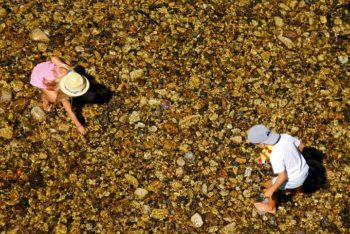
  • When students are fully engaged in learning, they are excited and motivated to apply newly developed skills to other daily activities. Children are engaged when they participate in scavenger hunts in their neighborhood that may include collecting nature products for math, reading, and writing activities. For example, students can gather different sizes of rocks, count them, and organize the rocks according to shapes and sizes. They can construct a math problem of how they added specific groups of rocks. Students can create a chart on how they grouped the rocks. They can take a picture of their collection and insert the image onto a Goggle slide. A reflective story can describe how a student found the rocks, grouped them, and solved a math problem. This reflective activity can reinforce what a student learned when participating in this activity.
  • The physical fitness teacher has students collect specific objects in the home. Then the student uses these objects when participating in physical fitness exercises. The teacher also has students learn exercise moves when dancing to music.
  • In addition to phonics review, Kenji has learned how to write a book. He creates books on various subjects. Kenji also learns how to research new concepts and facts in his reading materials.
  • Students are learning how to recycle and collect trash. They repurpose these items when completing art projects. They study how to conserve community resources in their social studies and science lessons.

[Read more…]

Joyce Iwasaki, Early Parenting

Joyce Iwasaki has over thirty years of educational experience working with diverse students in grades from preschool through high school. Joyce’s extensive background includes teaching elementary school, serving on early childhood advisory boards, and advocating for educational initiatives as a legislative aide. During her tenure as a legislative aide, she helped create legislation that allowed incarcerated mothers to keep their newborn babies with them while in prison. Additional legislation was enacted to allow incarcerated pregnant mothers to remain unshackled during labor and delivery. Ms. Iwasaki established and served as the president of an educational scholarship foundation for fifteen years. Her foundation awarded college scholarships to emerging student leaders who provided service to their schools and communities. Joyce is active in performing arts and cultural organizations. She also provides ongoing support to her daughter and family by raising her grandson in her home.

Written by Joyce Iwasaki, Early Parenting · Categorized: Elementary School Parenting, Grandparenting, Social-Emotional Health · Tagged: academic success, Educating children, family values, Grandparents' Influences, Parenting, parents as teachers, teachable moments

  • « Previous Page
  • 1
  • …
  • 3
  • 4
  • 5
  • 6
  • 7
  • …
  • 16
  • Next Page »

Search the site

Translate

Sign up for updates

Follow us

Copyright © 2026 — GenParenting • All rights reserved