 Twins! Double the Fun
As the grandma of twin girls, who will have their first birthday in a few weeks, I have been reflecting on how unprepared we were when we found out that our daughter would be giving birth to twins. After our initial shock and excitement, we needed to prepare a plan to adequately care for these precious bundles of joy along and their three-year-old brother. First, we read books about twin care to understand what was happening in the babies’ development. Our daughter also collected all of the hand-me-down clothes and baby gear that was offered from friends. She strategically planned on how to fit two babies in a smaller bedroom with all of the required gear. The following is a list of life-saving products that helped us care for our little granddaughters in their first months of life: [Read more…]

Mary Ann Burke, Ed.D., Digital Education Expert, is a substitute distance learning teacher for Oak Grove School District in San Jose, California and the author of STUDENT-ENGAGED ASSESSMENT: Strategies to Empower All Learners (Rowman & Littlefield: 2020). Dr. Burke creates digital language arts and substitute teaching K – 12 activities for teachers and parents. She is the Cofounder of the Genparenting.com blog. Burke is the former Director II of Categorical & Special Projects for the Santa Clara County Office of Education that supports 31 school districts serving 272,321 students in Santa Clara County. She is also a previous Director – State & Federal Compliance for Oakland Unified School District, the former Director – Grantwriter for the Compton Unified School District, and was the initial VISTA Director for the Community Partnership Coalition in southern California. Much of her work focuses on creating innovative digital trainings and partnership programs for teachers and families to support students’ learning. These programs were featured as a best practice at a National Title I Conference, California’s Title I Conferences, AERA Conferences, an ASCD Conference, the NASSP Conference, and statewide educator conferences.
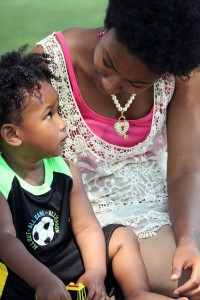
 As a grandma of infant twin baby girls, I spend hours caring and observing their various playful antics and needs in stimulating play activities. During the first six months, infants focus their days on eating, sleeping, and exploring their world with lots of loving cuddles. As your baby becomes more mobile by rolling, crawling, pulling up, and starting to walk, you can set up stimulating play areas to encourage exploration and redirect your baby from forbidden and dangerous explorations (i.e. extension cords, outlets, and small furniture that can topple on baby). These stimulating play areas can contribute to your baby’s cognitive, social-emotional, and large muscle growth. Babies love to move around and experience their environment. They love to play
  When my children were small, I used to read them Alexander and the Terrible, Horrible, No Good, Very Bad Day. I especially read the book to my daughters when they had a particularly difficult day. We would laugh at the various challenges Alexander would encounter throughout his very difficult day until bedtime when all was well when he drifted into dream land.
  About a year ago, my daughter and son-in-law were getting ready to choose a preschool for their daughter, who was not even three at the time. There were several alternatives, as well as pressure to get into a preschool before all were fully enrolled. One school even required that my granddaughter come and visit the school without her parents to see if it would be a good fit for one of the two remaining spots. This was hard to believe given her age.